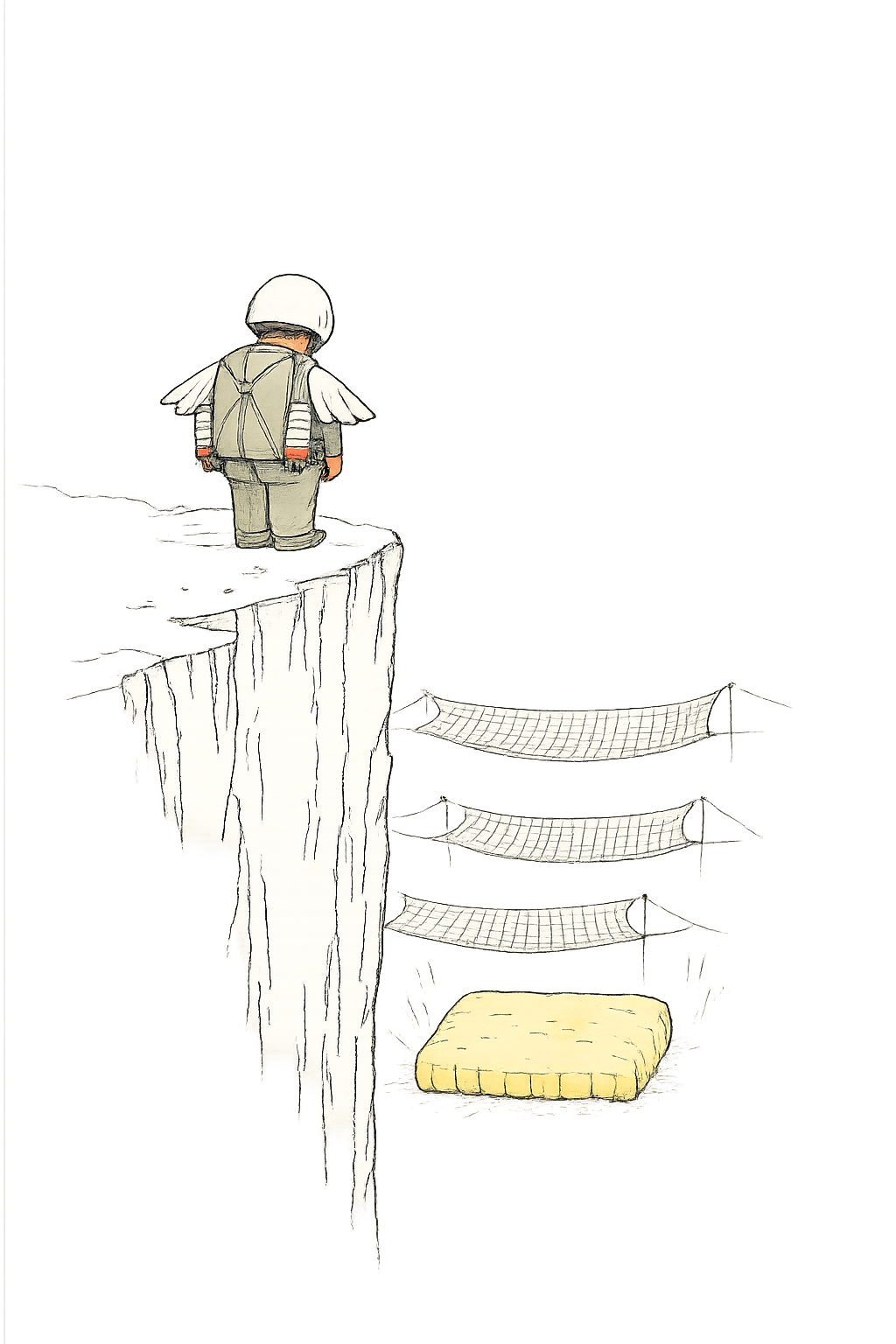
It AI'nt That Hard
A Developer's Guide to Directing AI,
While Pretending You Know What You're Doing
> The failures are real. The solutions are real.
> The questions don't have tidy answers._
Forty-seven merge conflicts on a Monday.
A senior iOS developer watches a four-minute demo, feels fifteen years of craft evaporate, and does what any rational person would do at midnight with a sleeping toddler upstairs: panics. It AI'nt That Hard is what happened next. Not the polished version — the real one.
This is the story of going from a twelve-word prompt that produced embarrassingly basic code to orchestrating eight parallel AI agents building a trading analytics platform. Along the way: an agent that passed empty tests for three days while nobody noticed, a PR approved with two critical files missing, and the slow reckoning with a job that changed shape while he was still learning to hold it.
The self-doubt was real -- 262-line workflow protocols, an existential crisis about craft, and the growing suspicion that all this infrastructure might be anxiety with a build system. This book is the story of working through that doubt -- of figuring out what you're actually good at when the machines get good at everything else.
"AI isn't psychic. It's you, if you had amnesia and had just walked into the office."Ch.2 — My First Prompt Was Embarrassingly Bad
"It's a particular kind of defeat, building something that works perfectly except for the one thing it needs to do."Ch.3 — The Dream That Died at 3 AM
"I shipped three features today. I wrote perhaps fifty lines of code myself. Some days I feel like a fraud."Ch.16 — The Oversight Economy
"Human reviewers don't catch this. They review what's there. They don't detect what's absent."Ch.12 — PR Review in Ninety Seconds
How to structure context so AI stops guessing
Context cascading, contract-first workflows, and the directory structures that make agents productive instead of expensive.
How to coordinate multiple AI agents without chaos
Isolated workspaces, branch protocols, and the coordination patterns that prevent forty-seven merge conflicts on Monday morning.
How to build guardrails that earn trust
Automated PR review, testing specialists, and observability for systems that fail quietly rather than cleanly.
How to catch what AI misses
Why agents pass empty tests, approve incomplete PRs, and confidently build the wrong thing — and the specific checks that prevent each failure.
How to keep documentation alive
Living documentation that updates itself, existence manifests that prevent duplicate work, and the cost of three-week-old lies.
How to think about what's left for the builder
The honest questions about craft, identity, and judgement that nobody talks about at conferences — asked honestly, answered incompletely.
Senior Developers
You've been writing code for years. The AI tools are impressive and unsettling in equal measure. You want honest guidance from someone who's been through the full adoption arc — including the failures the tutorials skip.
Tech Leaders
You're evaluating AI adoption for your team. You need to understand what actually changes — in workflow, in quality, in the economics of building software — from someone who tracked it obsessively.
The Honestly Curious
You suspect there's a space between "AI will replace us all" and "AI is just autocomplete" where the interesting work happens. There is. It's just messier than the demos suggest.

Before the book, there was the blog. The Accidental AI Orchestrator is a 17-part series documenting the same journey in real time — from installing Claude Code at midnight to orchestrating eight parallel agents on production code.
The blog tells the consultant's story. The book tells the full story — including the fear that started it, the self-doubt that nearly stalled it, and the questions about craft and identity that don't fit in a LinkedIn post.
Read the Blog SeriesFour days of careful engineering collapse when the fundamental assumption turns out to be wrong. No prior context needed. If this chapter resonates, the rest of the book will too.
Read Chapter 3 Free| Amazon | Leanpub | Gumroad | |
|---|---|---|---|
| Complete book | ✓ | ✓ | ✓ |
| DRM-free formats | Kindle only | PDF + ePub | PDF + ePub |
| Free future updates | — | ✓ | — |
| CLAUDE.md template | — | ✓ | ✓ |
| Workflow cheatsheet | — | ✓ | ✓ |
| Pre-flight checklist | — | ✓ | ✓ |
| Field Notes bonus PDF | — | — | ✓ |
| Quick-start guide | — | — | ✓ |
| Team license option | — | — | ✓ |
Join the mailing list and I'll send you Chapter 3 immediately — the strongest standalone story in the book. No spam. Just occasional notes about the book, the writing, and the ongoing experiment.
Unsubscribe anytime. I hate spam more than merge conflicts.